3DPrint
From Company Mascot to 3D Figurine: Turn Any Character Into a Physical Model
From Company Mascot to 3D Figurine: Turn Any Character Into a Physical Model
Characters are everywhere. A company may have a mascot representing its brand, a game developer may have an original hero, or a content creator may use a character as part of their online identity.
But these characters don't have to remain on a screen.
With 3D modeling and 3D printing, a 2D character, mascot, illustration, or existing digital design can be transformed into a physical figurine.
At Idea2Print3D, we explore how character concepts can move from digital artwork to real-world 3D models.
What Is a Custom 3D Character Figurine?
A custom character figurine is a physical 3D model created from a character design.
The starting point could be a company mascot, illustrated character, game character, cartoon-style design, original artwork, logo character, or an existing 3D model.
The character is recreated or prepared as a three-dimensional model and then optimized for 3D printing.
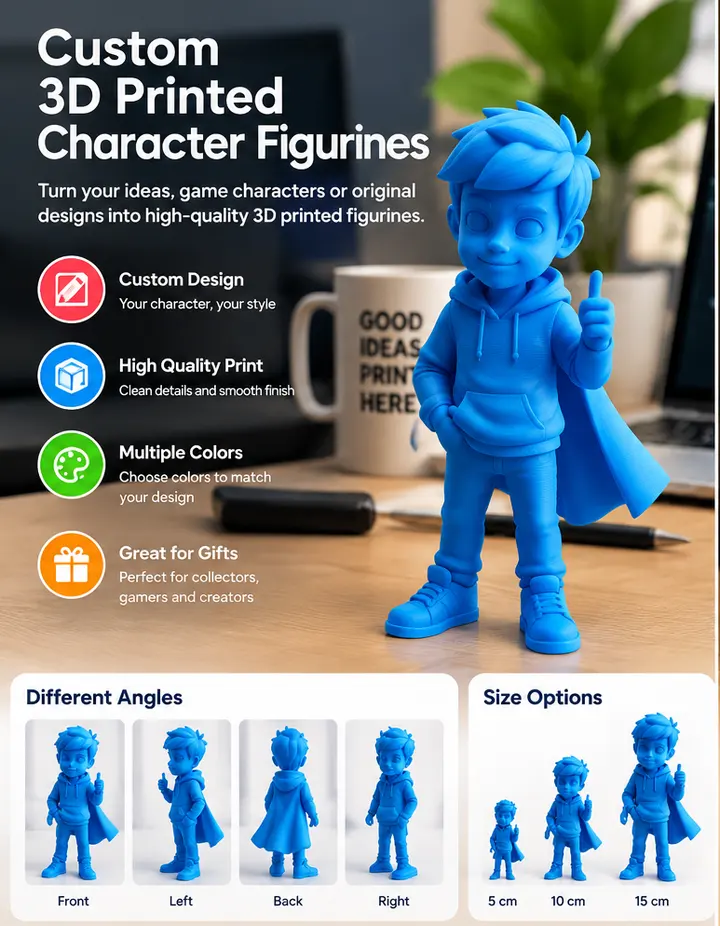
Our blue figurine is an example of this concept. It demonstrates how a stylized character can become a standalone physical model while maintaining recognizable elements such as its hairstyle, clothing, pose, and accessories.
Company Mascots in 3D
A company mascot is particularly well suited to this process.
Businesses often invest significant effort into creating a recognizable mascot for websites, advertisements, packaging, social media, or events. Turning that mascot into a physical figurine creates another way to use the same brand identity.
For example, a company could create small mascot figurines for the office, reception desk, exhibitions, customer gifts, promotional campaigns, employee gifts, product photography, or branded displays.
Instead of the mascot existing only as an illustration, it becomes a physical representation of the brand.
What Types of Characters Can Be Made?
The process isn't limited to company mascots. Many types of original or authorized characters can potentially be converted into printable models, including:
- Company and brand mascots
- Original cartoon characters
- Game characters
- App mascots
- Website characters
- YouTube or social-media mascots
- Story and comic characters
- Educational characters
- Event mascots
- Product characters
- Creator avatars
- Existing 3D character models
The complexity of the final model depends on the quality of the reference material, desired size, character geometry, and level of detail.
Starting From a 2D Character
A character doesn't necessarily need to have an existing 3D model.
A business might only have a mascot as a PNG, illustration, concept drawing, or other 2D artwork.
The character can then be interpreted in three dimensions.
This involves determining elements that aren't necessarily visible in the original artwork—for example, the character's depth, side profile, back, clothing geometry, and how different components connect.
Multiple reference views are especially useful because they provide more information about the intended character design.
Starting From an Existing 3D Model
If a printable 3D model already exists, the workflow can be simpler.
However, models created for animation, games, or rendering aren't automatically suitable for physical manufacturing.
The geometry may need adjustments before printing. Very thin elements may need reinforcement, intersecting geometry may need correction, and the character may need a suitable pose and stable contact points.
The objective is to preserve the character's visual identity while making the geometry practical to manufacture.
From Character to Physical Figurine
A typical workflow can look like:
Character Reference → 3D Modeling → Model Optimization → Slicing → 3D Printing → Finishing
Each stage affects the final result.
For example, a detailed model printed at only a few centimeters tall may lose small facial or clothing details. Increasing the size can make those details easier to reproduce, but it also increases material consumption and printing time.
This is why preparing a character for manufacturing is just as important as creating the character itself.
Choose the Size and Color
Once a printable model exists, it can be adapted for different applications.
A small mascot could become a desk figurine. A medium version could be used as a company gift. A larger version could become part of an exhibition or office display.
Different filament colors can also be selected. A prototype might initially be printed in a single color—like our blue example—to evaluate the geometry before producing more elaborate versions.
Models can also be post-processed or painted when additional colors and details are required.
Why Create a Physical Company Mascot?
Digital branding is important, but physical objects create a different type of interaction.
Someone can pick up a mascot figurine, put it on their desk, photograph it, display it at an event, or keep it as a souvenir.
For companies, that opens possibilities for branded merchandise, promotional items, event giveaways, office decoration, prototypes, limited editions, and customer gifts.
And because 3D printing works well for relatively small production quantities, companies can experiment with physical mascot concepts without immediately committing to traditional large-scale manufacturing.
From Digital Character to Something You Can Hold
The interesting part isn't simply printing a figurine.
It's creating a bridge between digital character design and physical manufacturing.
A character that started as a sketch can become an illustration. The illustration can become a 3D model. And that model can eventually become a physical object.
That's the type of transformation we explore at Idea2Print3D:
Have a character. Create the 3D model. Make it printable. Bring it into the real world.